

// introduction
Growing businesses often start with off-the-shelf software because it is faster to adopt, easier to buy, and usually cheaper upfront. Tools like Trello, HubSpot, Shopify, and QuickBooks solve common problems out of the box — and for most early-stage businesses, that is exactly what you need.
But as workflows, integrations, and scale get more complex, generic tools can start creating hidden costs, workarounds, and growth friction. That is where the build-vs-buy decision starts becoming more strategic — and where understanding your options makes a real difference.
// off_the_shelf.appeal()
Why Off-the-Shelf Tools Are Attractive at First
Off-the-shelf software is attractive because it solves the immediate problem. You need a CRM? Sign up for one. You need project management? Pick a tool and start. There is no scoping, no development timeline, and no upfront investment beyond the subscription fee.
For businesses that are still figuring out their processes, this flexibility is genuinely valuable. You can test workflows, swap tools, and iterate without committing to anything permanent. The speed-to-value is hard to beat.
The problem is not the starting point. The problem is what happens when the business outgrows the tool — and the tool was never designed to grow with you.
// generic_tools.breakingPoints()
Where Generic Tools Start Breaking Down
As a business grows, the cracks in off-the-shelf software become harder to ignore. The tool that worked perfectly for a team of five starts creating friction at twenty. The CRM that handled fifty leads a month cannot manage five hundred without workarounds.
Tool Sprawl and Platform Lock-in
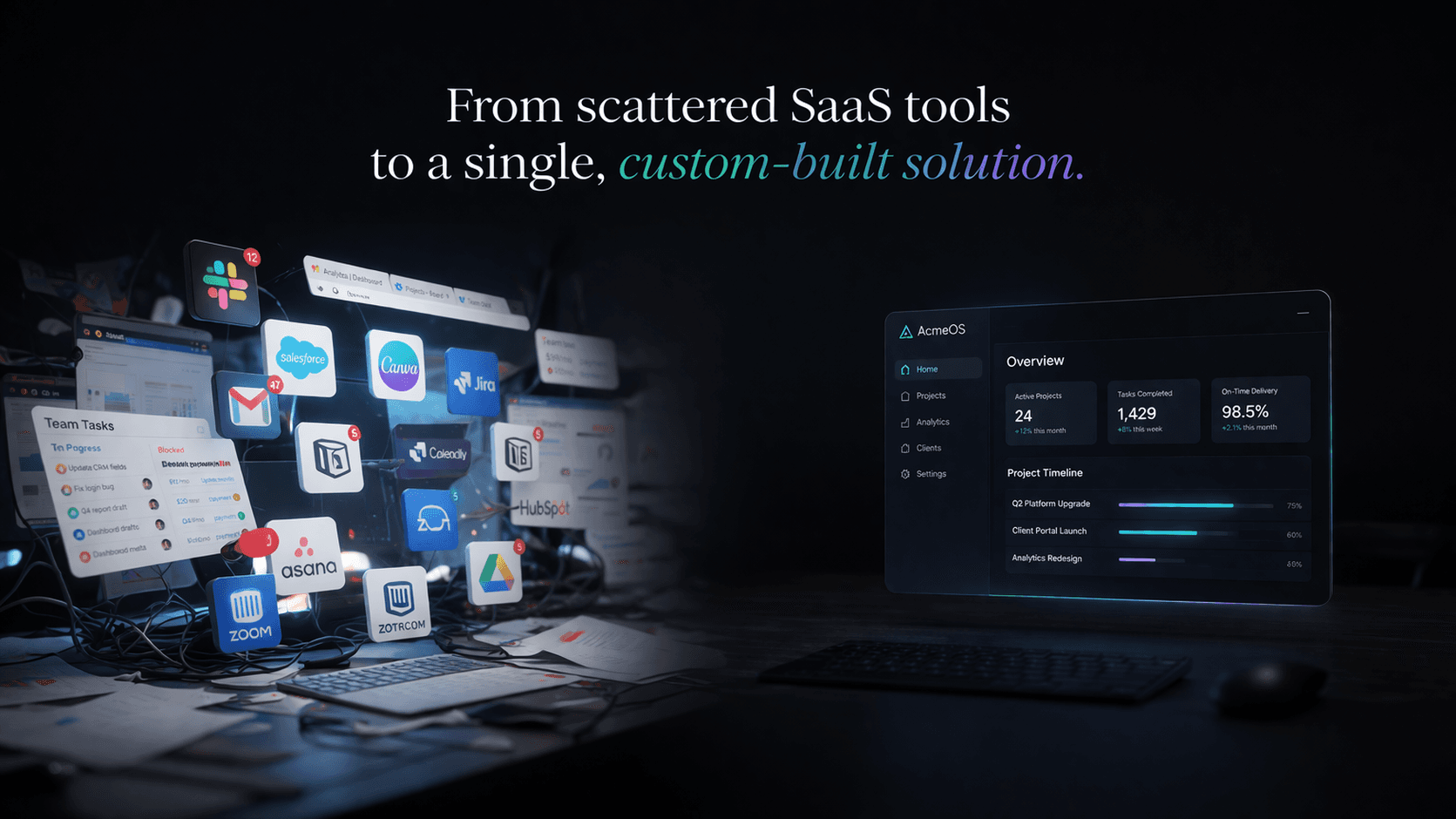
One of the first signs is tool sprawl — your business ends up using six, eight, or twelve different platforms that do not talk to each other. Data lives in silos. Teams copy-paste between systems. Reports require manual consolidation from multiple dashboards. The more tools you add, the more disconnected your operations become.
Why Integrations Become the Breaking Point
Most off-the-shelf tools offer integrations, but they are usually shallow. They sync basic data — contacts, status updates, notifications — but they rarely handle complex business logic. When you need Tool A to trigger a specific action in Tool B based on conditions from Tool C, you are either building brittle Zapier chains or hiring someone to write custom glue code anyway.
At that point, you are paying subscription fees for tools you are actively working around. That is the real cost — not the monthly invoice, but the productivity lost to software that no longer fits how your business operates.
// hidden_costs.calculate()
The Hidden Cost of Staying With Bad-Fit Software
The obvious cost of off-the-shelf software is the subscription. But the hidden costs are what really add up: per-user pricing that scales faster than your revenue, overlapping platforms doing similar jobs, add-on fees for features you assumed were included, and the hours your team spends on workarounds every week.
There is also an opportunity cost. When your operations team spends time managing software limitations instead of improving operations, growth slows down in ways that are hard to measure but easy to feel.
The question is not "how much does custom software cost?" — it is "how much is bad-fit software already costing you?"
// custom_software.advantages()
What Custom Software Actually Gives You
Custom software is not about building everything from scratch. It is about building the parts that matter most — the systems where your business logic is unique, where off-the-shelf tools cannot bend far enough, and where having full control creates a genuine competitive advantage.
That might mean a custom web application that replaces three separate tools. It might mean an internal dashboard that pulls data from every system your team uses. It might mean API integrations that connect your existing tools in ways their native integrations cannot.
The key difference is ownership. With custom software, you own the system. No per-user fees that scale against you. No feature gates. No dependency on a vendor's roadmap. The software works the way your business works — not the other way around.
// off_the_shelf.stillValid()
When Off-the-Shelf Is Still the Smarter Choice
Custom software is not always the answer. If your needs are standard, if the tools you use genuinely fit your workflow, and if the cost of switching outweighs the friction — off-the-shelf is the right call.
Accounting software, email marketing platforms, basic CRMs, and project management tools are almost always better bought than built. These are solved problems. The vendors maintain them, update them, and handle compliance — so you do not have to.
Speed Now vs Fit Later
Early-stage businesses should optimise for speed. Get the tool, learn your workflow, and validate your processes before investing in custom systems. Custom software makes the most sense when you already know what you need — because you have outgrown the generic version.
// when_to_build()
When Growing Businesses Should Consider Custom Software
The right time to consider custom software is when you start noticing patterns: your team is building workarounds every week. You are paying for three tools that should be one. Your data lives in silos that no integration can properly connect. Your operations have outgrown what generic software was designed to handle.
Specifically, custom software starts making sense when:
- ›Your workflows are unique enough that no off-the-shelf tool handles them cleanly
- ›You are paying for multiple overlapping subscriptions that could be consolidated
- ›Integration limitations are creating data silos and manual processes
- ›Per-user pricing is scaling faster than the value you are getting
- ›You need reporting or dashboards that span multiple systems
- ›Your team spends significant time on workarounds instead of actual work
If three or more of those sound familiar, it is worth exploring what a custom build could look like — even if the answer turns out to be better automation rather than a full platform.
// internal_to_product()
When Internal Systems Start Looking Like Products
Some businesses discover that the custom system they built for internal use solves a problem that others in their industry also face. A booking system, a client portal, an inventory management tool — what started as an internal solution sometimes has genuine product potential.
This is not a reason to build custom software. But it is worth knowing that when you own the code and the architecture, the option exists. With off-the-shelf tools, that door is never open.
// dukepaw.approach()
How DukePaw Studio Helps Businesses Make the Shift
At DukePaw Studio, we do not push custom builds when off-the-shelf tools are the right answer. Our process starts with understanding how your business actually operates — then we recommend the best path forward, whether that means connecting what you already have or building something new.
We build custom software and web applications, API integrations, business automation workflows, modern websites, and provide managed hosting and ongoing website care. Everything is scoped on a discovery call — no vague pricing, no surprises.
// conclusion()
Final Thoughts
The right software decision depends on where your business is today and how it expects to grow. Off-the-shelf tools are the right starting point for most businesses. Custom software becomes the smarter move when those tools start holding you back instead of pushing you forward.
The best approach is honest assessment: what is working, what is not, and what would a better system actually look like? Start there — and the right path usually becomes obvious.
// faq.render()
Frequently Asked Questions
What is the difference between custom software and off-the-shelf software?
Off-the-shelf software is built for broad common use cases and usually comes with standard workflows, subscription pricing, and limited customization. Custom software is built around a business's specific requirements, workflows, and logic.
Is custom software always better than off-the-shelf tools?
No. Off-the-shelf tools are often the better choice when needs are standard, speed matters, and the business is not yet complex enough to justify a custom build.
When should a growing business consider custom software?
A growing business should consider custom software when it is dealing with workflow mismatch, integration pain, tool sprawl, repeated workarounds, reporting limitations, or software that no longer fits the way the business actually operates.
Why do off-the-shelf tools become expensive over time?
They can become expensive through recurring subscription fees, per-user pricing, overlapping platforms, add-ons, workarounds, and productivity loss caused by software mismatch.
Can custom software become the foundation for a SaaS product?
In some cases, yes. Businesses sometimes discover that a unique internal workflow or system has broader product potential, especially when existing software does not solve the problem well.