

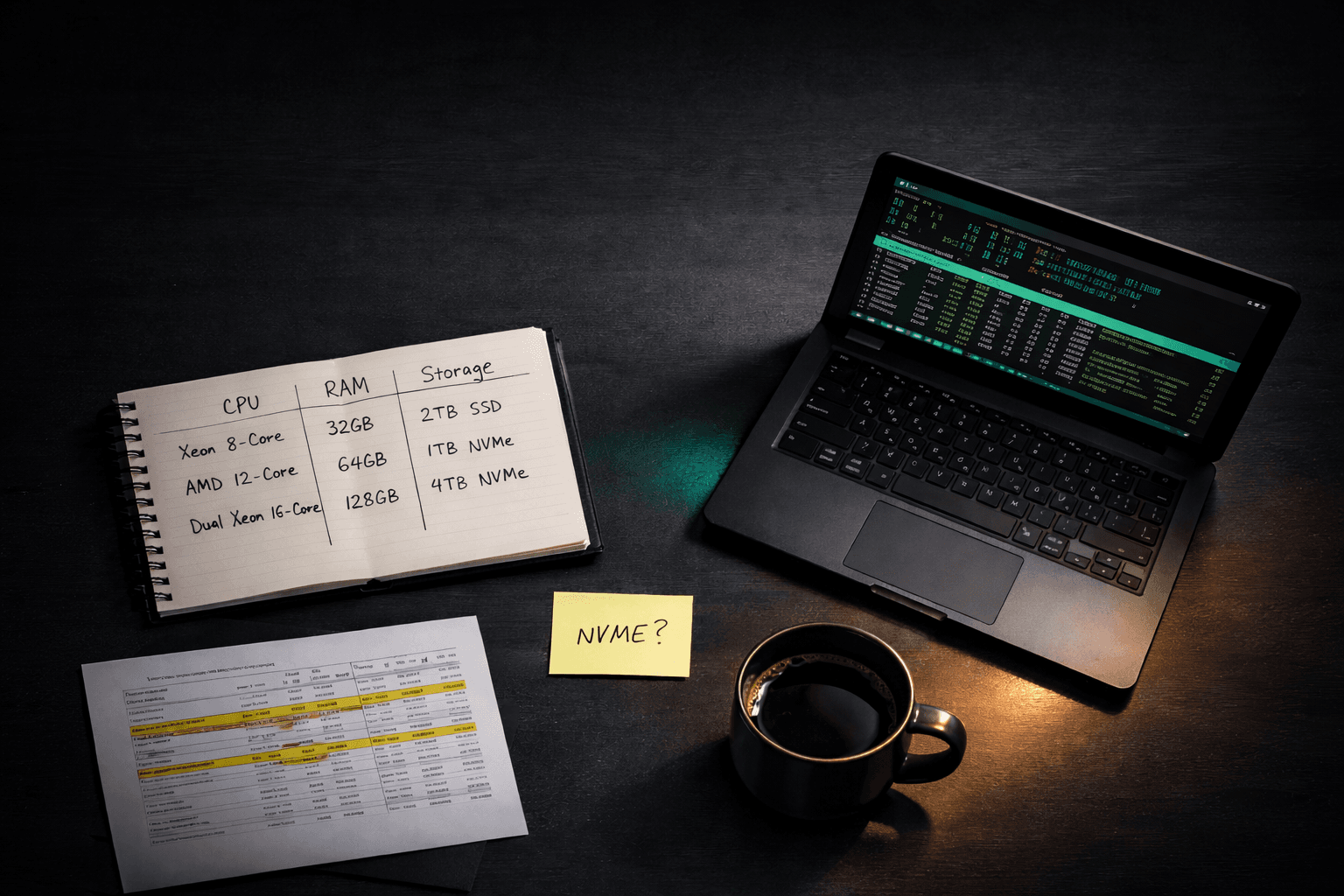
// introduction
When I started researching VPS services for DukePaw Studio, I thought I was making a hosting decision. The deeper I got into it, the more obvious it became that I was really making an infrastructure decision. Choosing the right VPS is not just about getting a server online — it is about deciding what kind of stability, speed, storage, and long-term capacity your business will stand on.
This article is a look into how we approached that process — what I was looking for, what I learned along the way, and why we ultimately settled on the setup we use today.
// research.begin()
Why I Started Looking Deeper Into VPS Infrastructure
DukePaw Studio is not a side project. It is a working agency that builds websites, software, automations, and digital systems for real businesses. That means the infrastructure behind our own platform — and behind our client work — needs to be more than just functional. It needs to be genuinely reliable.
Before I started this research, we were running on a setup that worked, but I could see it would not be enough as the studio grew. More client sites, more traffic, more complex applications — the workload was going to increase, and I wanted to make sure the environment underneath could carry it without us having to scramble later.
Research note
That is what pushed me to start looking at VPS options properly — not as a quick upgrade, but as a long-term infrastructure decision.
// requirements.define()
What I Was Really Looking For in a VPS Environment
I was not looking for the cheapest option or the one with the flashiest marketing page. I wanted an environment that could genuinely support what we do — which is web development, software development, managed hosting, and long-term website care for clients who depend on us.
That meant the VPS had to deliver on several things at once:
Priority matrix
// research.evaluate()
What Mattered Most During the Research Process
The research process taught me something early on: most VPS providers lead with headline numbers — cores, storage space, bandwidth — but the real difference between providers is in the quality behind those numbers. A “4-core VPS” from one provider is not the same as a “4-core VPS” from another if the underlying hardware, network, and support standards are different.
Why Uptime Matters More Than People Think
Uptime is one of those numbers that looks the same everywhere until you actually calculate the difference. The gap between 99.9% uptime and 99.99999% uptime is not a rounding error — it is the difference between hours of annual downtime and seconds. For a business that depends on its website and email being available, that gap matters.
Research note
Why NVME Storage Stood Out
Storage speed was one of the areas where the research kept pointing in the same direction. NVME storage is significantly faster than traditional SSD setups, and the impact is felt everywhere — page load times, database queries, file serving, backup operations, and the general responsiveness of the server environment.
It was not the cheapest option, but it was the one that made everything else work better. Once I understood the performance difference, it was hard to justify choosing anything slower for what we needed.
// specs.matter()
Why Storage, Memory, and CPU Changed the Conversation
Early in the research, I was comparing VPS options mostly on price and basic specs. But as I dug deeper, the conversation shifted from “what can we afford” to “what does the business actually need to operate well?”
CPU matters because we run real applications — not just static sites. Memory matters because those applications need room to operate without starving each other. Storage matters because client data, backups, media files, and databases all need space — and they grow faster than most people expect.
Research note
That shift — from “what is the minimum” to “what gives us real room to grow” — is what changed the direction of the entire search.
// decision.final()
Why We Settled on Our Current VPS Setup
After weeks of comparing providers, reading documentation, and testing environments, we settled on a Linux VPS setup that met every requirement on our list — and gave us significant headroom beyond that.
The decision was not based on a single feature. It was based on the full picture: the hardware quality, the storage speed, the network reliability, the backup strategy, the operating system flexibility, and the long-term confidence that the environment could carry the business forward without needing a full migration in twelve months.
Why the Right Operating System Matters Too
We chose AlmaLinux 10 as our operating system. It is a community-driven enterprise Linux distribution that picked up where CentOS left off — stable, well-maintained, and built for long-term production use. For a business server that needs to run reliably for years, the operating system is not a cosmetic choice. It is a foundational one.
AlmaLinux gave us the stability and compatibility we needed without the licensing overhead of Red Hat Enterprise Linux. It was the right fit for how we operate.
// server.status()
What Our Current DukePaw Studio Server Environment Looks Like
Here is the infrastructure that DukePaw Studio currently operates on. This is not a wishlist — it is what is running right now, supporting our own platform and our client work.
Servers ─── x2 Linux VPS
CPU ─── 24 vCPU Cores
Memory ─── 64 GB
Storage ─── 12 TB NVME
Network ─── 500 Mbps
OS ─── AlmaLinux 10
Backups ─── Bi-Weekly
Uptime ─── 99.99999%
24
across 2 servers
64 GB
DDR4 ECC
12 TB
high-speed SSD
99.99999%
near-zero downtime
// lessons.learned()
What This Research Taught Me About Hosting Properly
The biggest takeaway from this process was that hosting is not something you buy once and forget about. It is a commitment to a standard. The environment you choose shapes how everything else performs — your website, your email, your applications, your backups, and ultimately your ability to deliver on promises to clients.
What I Would Tell Another Founder Researching VPS for the First Time
Do not start with price. Start with what your business actually needs to operate well — and then find the environment that meets that standard. It is easy to underbuy and regret it later, but it is very hard to migrate a live business environment to a better server under pressure.
Research note
Good hosting is not an expense. It is part of a company's standard — and the standard you set for your own infrastructure says something about the standard you set for your client work.
// final_thoughts()
Final Thoughts
The right VPS setup gives a company far more than server space. It gives it breathing room, stability, performance, and a stronger technical base behind everything it wants to build.
That is exactly why DukePaw Studio settled on its current Linux VPS environment — not because it looked good on paper, but because it matched the standard we want the business to stand on. And that standard is something we carry into every project we take on.
// faq.render()
Frequently Asked Questions
What is a VPS server?
A VPS, or Virtual Private Server, is a hosting environment that gives a business dedicated resources inside a virtualized server setup. It offers more control and more predictable performance than basic shared hosting.
Why does choosing the right VPS matter?
Because the VPS environment affects performance, storage, uptime, backups, stability, and how well a business can grow over time without running into avoidable infrastructure problems.
What should a business look for in a VPS?
A business should look for strong CPU resources, enough memory, fast storage, a reliable operating system, a sensible backup strategy, good network performance, and a provider that understands long-term reliability.
Why does NVME storage matter in a VPS?
NVME storage helps create a faster, more responsive environment. It improves the overall feel of the system and gives the server a stronger performance base than slower storage setups.
What operating system does DukePaw Studio use on its VPS servers?
DukePaw Studio runs its current VPS environment on AlmaLinux 10.
What VPS setup does DukePaw Studio currently use?
DukePaw Studio currently runs x2 Linux VPS Servers with 24 vCPU Cores, 12 TB NVME Disk Space, 64 GB Memory, Bi-Weekly Backups, AlmaLinux 10, 500 Mbps network speed, and 99.99999% uptime.