

// introduction
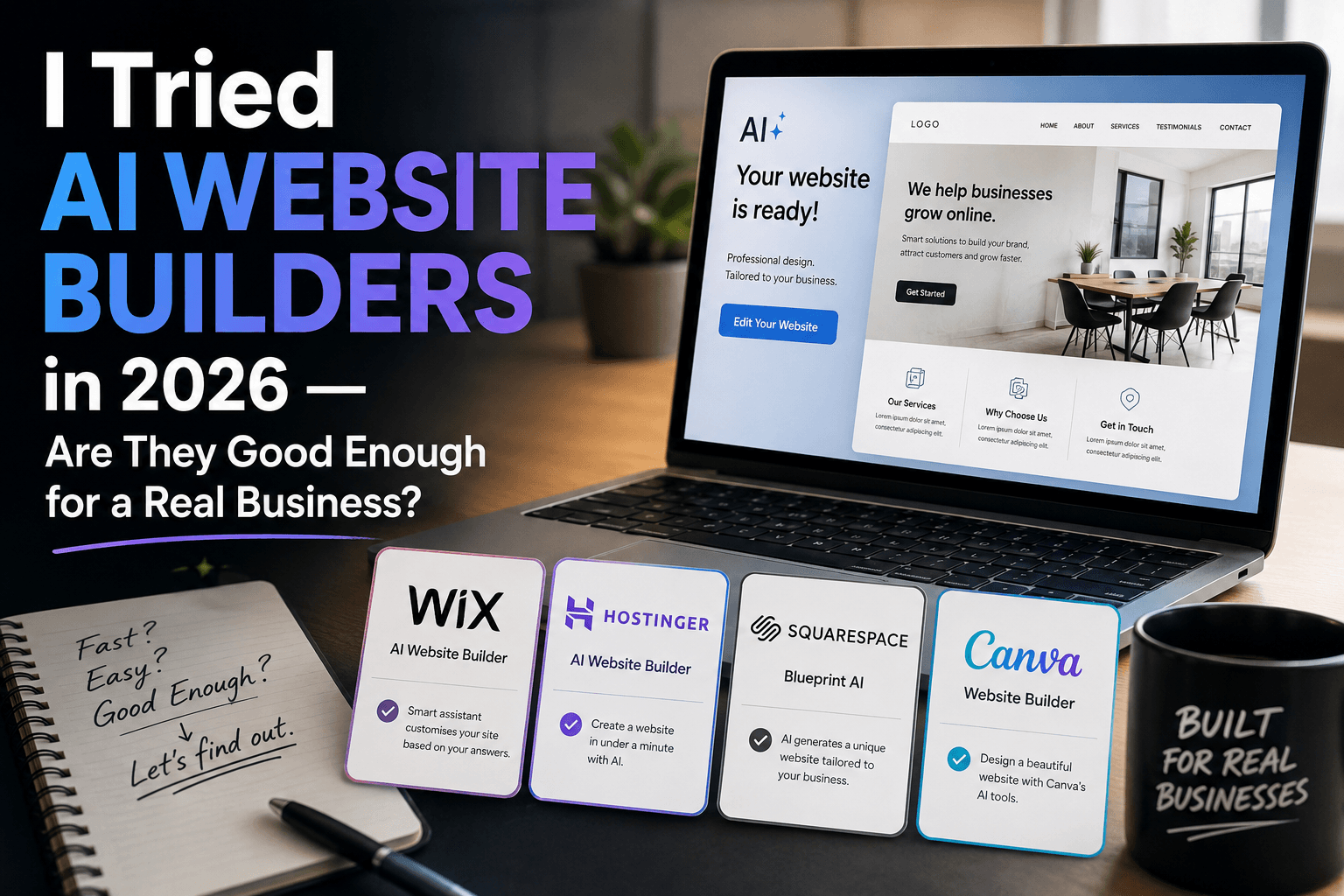
AI website builders are everywhere now. Every second advert says the same thing: "Build your website in minutes." "No coding needed." "Let AI create your full business website." And to be fair, the technology has come a long way. A few years ago, most builders were template swaps — pick a layout, change the colours, drop in your logo, hope it looked professional. Now the promise is much bigger: describe your business, answer a few questions, and the AI generates the whole thing.
So I wanted to test the real question behind the hype: are AI website builders good enough for a real business website? Not a hobby site. Not a throwaway landing page. A proper business website — one that builds trust, brings in leads, explains your services, ranks on Google, works on mobile, and still makes sense six months from now.
// The short answer: they're impressive, but they're not magic. They'll get you a decent first draft fast. Whether that draft is good enough for your business depends entirely on what you need it to do.
// how_i_evaluate()
How I Look at a Business Website
I use AI in my own workflow every day, so this isn't a hit piece. But I also build websites for real clients, so I don't only ask "does it look nice?" I ask whether it explains the business clearly, whether customers will understand what to do next, whether it actually works on mobile, whether the structure is good for SEO, whether it can grow with the business, and whether the owner actually controls what matters.
A website isn't a digital brochure anymore. It's the first impression, the sales assistant, the lead capture system, and sometimes the main operating tool. That's the bar I tested against — from the perspective of a small business owner who wants something professional but doesn't know the technical side.
// what_they_get_right()
What They Genuinely Get Right: Speed
This is where AI builders shine. Type in a description, pick a style, answer a few questions, and within minutes you have something that looks like a website. If you've never built one before, that matters. A blank page is paralysing — you don't know what sections you need, how to structure a homepage, what to write, or where to put the buttons. AI removes that blank-page pressure. Instead of starting from nothing, you start from something.
For a brand-new owner still figuring things out, that momentum is real and valuable. But speed is only one part of the equation. A site built in five minutes can still cost you leads if the message is weak, the design feels generic, or the customer doesn't trust what they're seeing.
// design.review()
The Design Is Decent — But Usually Generic
Most AI builders now produce something clean at first glance. Reasonable spacing, sensible section order, a hero, some service blocks, a testimonial, a contact form, a footer. For a lot of businesses that already beats an outdated site from 2012.
But look past the first impression and the designs start to feel familiar. Polished, but not specific. It looks like a business website — not like your business website.
That's the gap. Good design isn't just looking modern; it's creating the right feeling for the right audience. A law firm shouldn't feel like a coffee shop. A security company shouldn't feel soft and playful when the brand needs to signal strength. AI makes things look neat, but it doesn't understand positioning, market, customer objections, or local context. That's still human work.
// copywriting.tell()
The Copywriting Is Where It Becomes Obvious
This was the biggest tell. AI generates copy fast, but a lot of it sounds like AI copy:
" Your trusted partner for quality solutions. "
" We are passionate about helping businesses grow. "
" Experience excellence with our professional services. "
None of it is wrong. It just doesn't say anything. Real copy has to answer real questions: What problem does this business solve? Why choose them over someone else? Are they local? Experienced? Trustworthy? What happens after I contact them? How much does it usually cost?
Customers can feel when copy is empty. A beautiful website with weak copy is a nice shop with nobody at the counter — it looks good, but it doesn't sell. AI gives you a first draft; turning it into something human, specific, and trustworthy still takes editing.
// seo.structure()
SEO Is Not Just Ticking a Box
Most builders advertise SEO tools, and yes — you usually get the basics: editable titles, descriptions, headings, alt text, sometimes keyword suggestions. That's helpful. But SEO starts with structure: how pages are planned, how services are separated, how headings and internal links work, how fast the site loads, and whether Google can clearly understand what each page is about.
If a business offers web design, hosting, SEO, and software development, cramming all of it onto one generic "Services" page usually isn't enough. Each service often needs its own page — its own structure, content, metadata, FAQs, and call to action. AI builders tend to produce sites that look acceptable but are shallow underneath. For a deeper look at this, see our guide on SEO for small businesses.
// Being online is not the same as being found.
// mobile.matters()
Mobile Matters More Than People Think
Most people will see your website on a phone first, which makes the mobile version the most important one, not the afterthought. AI builders generally make layouts responsive — but "responsive" doesn't always mean "good." The desktop can look fine while mobile feels too long, too cramped, or repetitive. Buttons don't stand out. Images crop strangely. Sections stack in a way that technically works but doesn't feel polished.
A good mobile site feels effortless: the visitor instantly knows where they are, what's on offer, and how to act — no pinching, zooming, or hunting for the contact button. AI can build a mobile version. It still needs a human eye. If you want the full picture on why this matters commercially, we cover it in why fast websites win more customers.
// where_useful()
Where AI Builders Are Genuinely Useful
I'm not saying they have no place — they absolutely do. They're a great fit for:
Early-stage ideas
Testing a business idea, or getting a rough first draft out of your head and onto a screen quickly.
Simple presences
Personal sites, simple portfolios, and temporary landing pages that don't need to do much.
Tight budgets
Getting started when the budget is extremely limited and something basic online beats nothing at all.
Inspiration
Generating layout sections and structure ideas that a human can then refine and build on properly.
For someone with nothing online, an AI-generated site may well be better than no site at all. But the key word is basic. The moment the site needs to become a serious business asset, the limits show.
// where_they_fall_short()
Where They Start Falling Short
The real issue isn't that AI builders can't make a website. They can. It's that they tend to make the samewebsite for very different businesses. Real businesses aren't the same. Some need online bookings. Some need payments, custom forms, client dashboards, quote calculators, product catalogues, private portals, software integrations, proper hosting control, or serious speed and SEO work.
That's where custom development still makes sense — a serious site is built around the business model, not around a template. That doesn't mean it has to be complicated. Simple is often better. But there's a big difference between a website that's intentionally simpleand one that's just shallow.
// ownership.question()
The Ownership Question
This is the part most owners don't think about early. When you build inside a website builder, you're tied to their platform — their pricing, their editor, their limitations, their hosting, their rules. For some businesses that's fine. For others it becomes a problem later:
Custom features
What happens when you want a feature the builder simply doesn't support?
Moving away
What happens when you want to move the site elsewhere, or need deeper integrations?
Performance
What happens when speed and performance become a real business issue?
Outgrowing it
What happens when your business outgrows the platform entirely?
A website isn't only about what you need today. It's about what you'll need next year. Ownership and scalability are exactly what protect that.
// so_are_they_enough()
So — Are They Good Enough for a Real Business?
Sometimes, but not always. If you need a simple online presence and you're comfortable with a generic structure, an AI builder is a fine starting point. If you're a freelancer, a hobby creator, or a brand-new business testing an idea, it might be enough for now.
But if your website needs to build trust, rank properly, generate leads, reflect your brand, support real features, and grow over time, AI alone probably isn't enough. The site may look finished without being strategically finished. A real business website needs more than a layout — it needs direction, proper content, structure, performance, trust, SEO, and a clear path for the customer.
// my_honest_takeaway()
My Honest Takeaway
AI website builders aren't the enemy. They're tools — and the result depends on how they're used. They help with speed, ideas, first drafts, and basic sites, and they lower the barrier for people who'd otherwise never start. That's a good thing.
But they don't replace proper planning, design judgment, strong copywriting, technical structure, SEO thinking, and long-term strategy. The best use of AI in web design isn't to hand it the whole process — it's to let it speed up parts of the process while a human still makes the decisions that matter. Use AI to move faster. Just don't let it decide everything for your business. Your website is often the first serious impression people get of your company. It shouldn't feel like something quickly generated and forgotten — it should feel like your business. Clear, professional, trustworthy, and built with purpose.
// final_verdict()
Final Verdict
AI website builders in 2026 are impressive, and they'll only get better. For now, treat them as a starting point, not the final answer. They're good enough for quick drafts, simple sites, and early-stage ideas — not always good enough for a business that needs a proper digital foundation.
// Before you choose the fastest option, ask a better question: Do I just need a website online, or do I need a website that actually works for my business? Those are two very different things.
// frequently_asked_questions()
Frequently Asked Questions
Are AI website builders good enough for a real business website?
Sometimes, but not always. AI website builders are great for simple sites, first drafts, and early-stage ideas. But a business that needs to build trust, rank on Google, generate leads, support real features, and grow over time usually needs more than an AI builder produces on its own.
What are AI website builders actually good at?
Speed and removing the blank-page problem. They can generate a decent first draft of layout, structure, sections, and copy within minutes. For someone with no design or coding experience, that early momentum is genuinely valuable.
Why does AI-generated website copy often fall flat?
It tends to be generic and vague, with lines like 'your trusted partner for quality solutions.' Real copy has to answer specific customer questions: what you do, who you help, why you're different, and what happens next. That usually takes human editing before it sounds specific and trustworthy.
Do AI website builders handle SEO properly?
They cover the basics like titles, descriptions, headings, and alt text. But real SEO starts with structure: separate service pages, clear headings, internal links, fast loading, and content that matches search intent. AI builders often produce sites that look acceptable but are shallow underneath.
Should I use an AI website builder or hire a developer?
Use an AI builder if you need a simple online presence quickly or you're testing an idea. Choose custom development when the website must build trust, rank, convert, support real business features, and grow — and when you need to genuinely own and control what matters.