 DukePaw Studio
// introduction
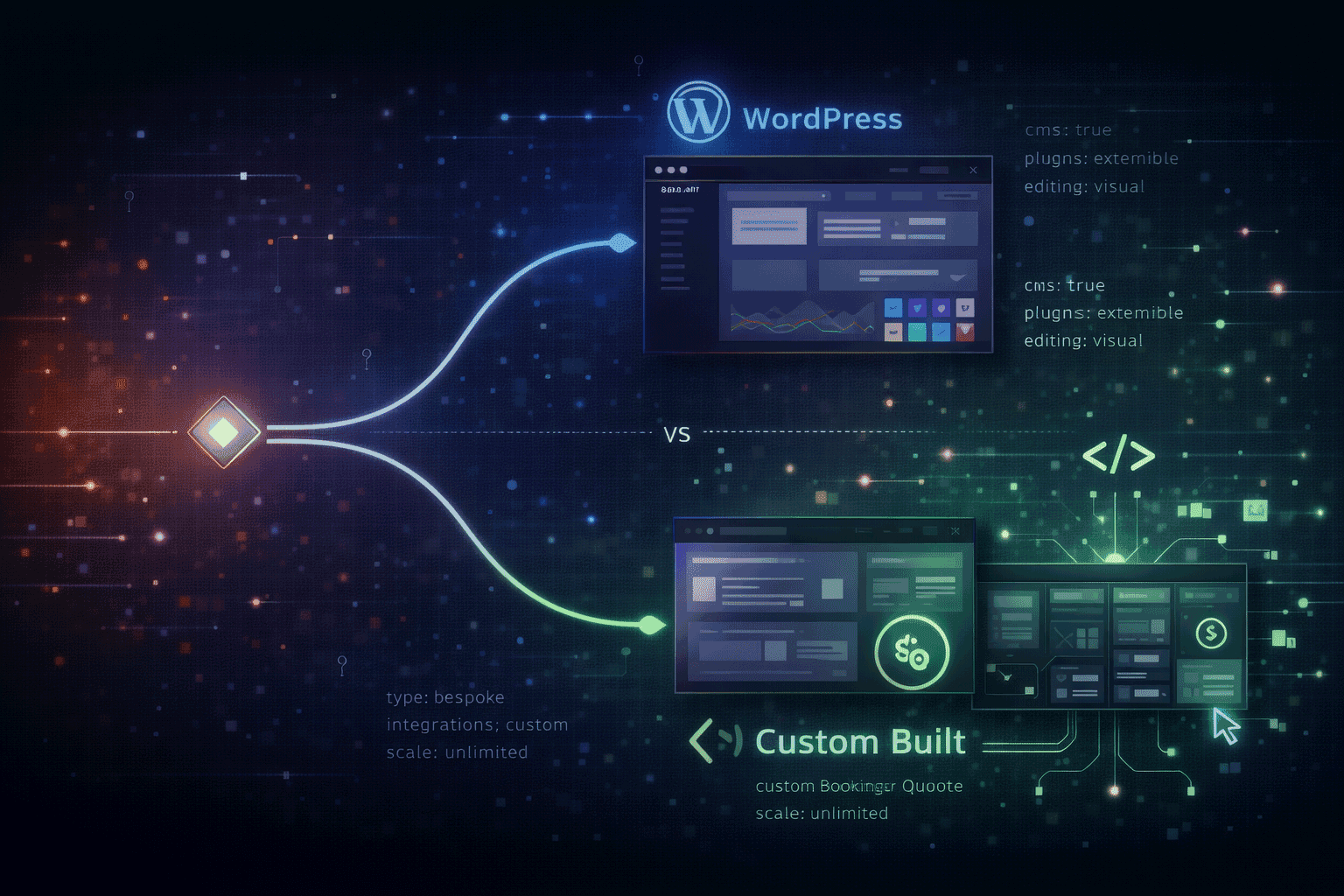
If you are planning a new business website, one of the biggest decisions you will face is whether to use WordPress or a custom-built website. WordPress positions itself as an open-source publishing platform with flexible design tools and broad extensibility, while custom frameworks are increasingly used for faster, more tailored digital experiences.
The real question is not which technology sounds better, but which option fits your business goals, content needs, and long-term growth best. This guide breaks down both sides practically — no ideology, just what works.
// framing()
Why This Is a Business Decision, Not a Tech Debate
Developers have strong opinions about WordPress. Some swear by it. Others dismiss it entirely. But your business does not care about developer preferences — it cares about what works.
The right answer depends on a handful of practical questions: How often does your team need to edit content? How complex are your site's features? How important is performance and SEO? What happens when your business outgrows the current setup?
Once you answer those, the technology choice usually becomes obvious. For a deeper technical comparison of specific frameworks, see our guide on the best tech stack for small business websites in 2026.
// wordpress.strengths()
What WordPress Is Best For
When a Standard CMS Is Enough
WordPress is built around content management. Its visual editor, block-based page builder, and massive plugin ecosystem make it one of the most accessible platforms for non-technical teams to manage a website day-to-day. WordPress's own documentation highlights editing tools and extensibility as core strengths.
If your business primarily needs editable pages, blog posts, landing pages, contact forms, basic e-commerce, and integration with common marketing tools — WordPress handles all of that with lower initial development cost than custom alternatives.
Content-heavy businesses
Blogs, news sites, portfolios, and businesses that publish regularly benefit from WordPress's editing workflow.
Marketing-driven sites
Landing pages, lead capture forms, A/B testing plugins, and broad third-party marketing integrations.
Budget-conscious builds
When the business needs a professional site quickly without the budget for fully custom development.
Team self-service
When multiple people need to update content without relying on a developer for every change.
// custom.define()
What a Custom-Built Website Usually Means
When the Website Starts Acting More Like Software
A "custom-built" website does not mean everything is written from scratch. It means the site is built on a modern framework — like Next.js, Astro, or similar — where the design, functionality, performance, and architecture are tailored to the business rather than assembled from pre-built plugins.
Custom builds make sense when the site needs to do things that WordPress plugins struggle with: deep integrations, custom dashboards, user account systems, booking or quoting flows, real-time data, or business automation connected directly into the site.
Application-like features
Client portals, booking engines, quoting tools, user dashboards, or real-time data displays.
Custom integrations
CRM syncing, payment processing, inventory systems, or third-party API connections built to your exact workflow.
Performance-critical sites
When Core Web Vitals, load speed, and SEO ranking are non-negotiable business requirements.
Long-term scalability
When the website will grow into a platform with multiple services, user types, or data-driven functionality.
// when_wordpress()
When WordPress Is the Smarter Choice
WordPress is the smarter choice when your business needs a website that your team can manage independently, where the primary content types are pages, posts, and forms, and where the functionality you need is well-covered by established plugins.
If your site is primarily a marketing tool — driving awareness, capturing leads, publishing content, and supporting digital marketing campaigns — WordPress paired with proper managed hosting and website care can serve you well for years.
// when_custom()
When a Custom-Built Website Is Worth It
A custom build is worth the investment when your business needs go beyond what a CMS can reliably handle. If you're building client portals, complex quoting systems, multi-step booking flows, or custom software that lives inside your website — that's custom territory.
Custom sites also make sense when performance is a core business requirement. If your revenue depends on search rankings, page speed, and conversion rates — the control you get from a custom web development approach is hard to replicate with plugins.
// decide(your_business)
Which One Is Right for You?
Here is a simplified decision framework. It won't cover every edge case, but it will point you in the right direction:
function chooseStack(business) {
if (business.needs === "editable content + blog + forms")
return "WordPress";
if (business.needs === "speed + SEO + static content")
return "Custom (Astro)";
if (business.needs === "dashboards + integrations + scale")
return "Custom (Next.js)";
if (business.needs === "CMS content + custom app features")
return "Hybrid approach";
return "Book a discovery call"; // let's figure it out together
}
// trade_offs.analyse()
The Real Trade-Off: Editability vs Flexibility vs Complexity
Every platform choice involves trade-offs. Understanding what you gain and what you trade is how smart businesses make this decision:
You gain
+ Visual editing without developers
+ Thousands of plugins available
+ Lower initial development cost
+ Familiar for most teams
You trade
- Limited custom functionality
- Plugin sprawl creates tech debt
- Performance depends on theme quality
- Security surface area is larger
You gain
+ Full control over design and function
+ Superior speed and SEO performance
+ Tailored integrations and workflows
+ Scales without plugin limitations
You trade
- Higher initial development cost
- Requires developer for most changes
- Longer initial build timeline
- Content editing needs a CMS layer
Why Bad Implementation Ruins Either Option
A poorly built WordPress site — bloated with plugins, hosted on cheap shared hosting, with no SEO structure — will underperform just as badly as a custom site built by someone who doesn't understand business requirements. The platform matters, but the quality of the build matters more.
The hybrid option
Some businesses use WordPress for content management and blogging while running a custom frontend or microservice for the application-like parts — booking engines, client portals, or data-driven features. This "headless" approach gives you the best of both worlds: easy content editing where you need it, and full custom power where the business requires it. It's more complex to set up, but for the right business it's the ideal middle ground.
// hosting_and_care()
Hosting, Maintenance, and Support Matter Either Way
Whichever route you choose, the operational layer still matters. WordPress sites need plugin updates, security patches, and performance monitoring. Custom sites need framework updates, dependency management, and deployment pipelines.
In both cases, proper managed hosting with CDN, SSL, backups, and uptime monitoring — plus ongoing website care for updates and performance reviews — is what keeps the site performing well after launch. The framework is the foundation. The hosting and care are the roof and walls.
// long_term.plan()
How to Think About Long-Term Fit
The biggest mistake businesses make is choosing a platform for where they are today without thinking about where they'll be in two years. A WordPress site that works perfectly now might buckle under the weight of 30 plugins, while a custom build that's overkill today might be exactly what the business needs by next year.
// The cheapest website platform is the one you don't have to rebuild in 18 months. Choose for where your business is going, not just where it is right now.
The best investment is choosing a partner who understands both options and can recommend the right fit — and who can help you migrate smoothly if your needs change down the road.
// dukepaw_studio.guide()
How DukePaw Studio Helps Businesses Choose the Right Path
At DukePaw Studio, we don't default to one platform for every project. We help businesses choose the right website foundation based on what the site actually needs to do — whether that means a well-built WordPress setup for content and marketing, or a custom solution for deeper functionality and long-term growth.
Because our services also include software development, API and integration, business automation, managed hosting, website care, and digital marketing, we can support either direction — and help you transition between them if your business evolves.
Every project starts with a discovery call where we understand your situation, your goals, and your constraints — then recommend the path that actually fits. No blanket answers. No upselling. Just the right choice for your business.
// conclusion()
Final Thoughts
The right website platform is not the one with the loudest hype. It is the one that fits the real needs of the business. WordPress vs custom-built websites is not a contest — it's a question of fit.
Some businesses thrive on WordPress for years. Others outgrow it in months. The key is choosing intentionally — with a clear understanding of your content needs, your feature requirements, and where your business is headed — rather than defaulting to whatever a developer happens to prefer.
// frequently_asked_questions()
Frequently Asked Questions
Is WordPress still a good option for business websites?
Yes. WordPress is an open-source publishing platform with flexible design tools and broad extensibility through themes and plugins. That makes it a strong fit for many businesses that need editable pages, blogs, landing pages, and standard marketing functionality.
When is a custom-built website better than WordPress?
A custom-built website is usually the better choice when the business needs more specific functionality, stronger design control, custom workflows, deeper integrations, or software-style features that go beyond what plugins can reliably handle.
Is WordPress always cheaper than a custom website?
Not automatically. WordPress is often more practical for standard business sites, but costs depend heavily on how the site is built, hosted, maintained, and extended. A poorly built WordPress site can become expensive to fix, while a custom site only makes sense when the business genuinely needs that extra flexibility.
What is the biggest difference between WordPress and custom development?
The biggest difference is usually the balance between editability and flexibility. WordPress is built around content management and broad plugin-based extensibility, while custom frameworks are better suited to more tailored performance and application-style requirements.
Does hosting and maintenance matter in both cases?
Yes. Whichever route a business chooses, hosting, performance, security, updates, and ongoing care still matter. Both WordPress and custom sites need proper infrastructure and maintenance to perform well long-term.